
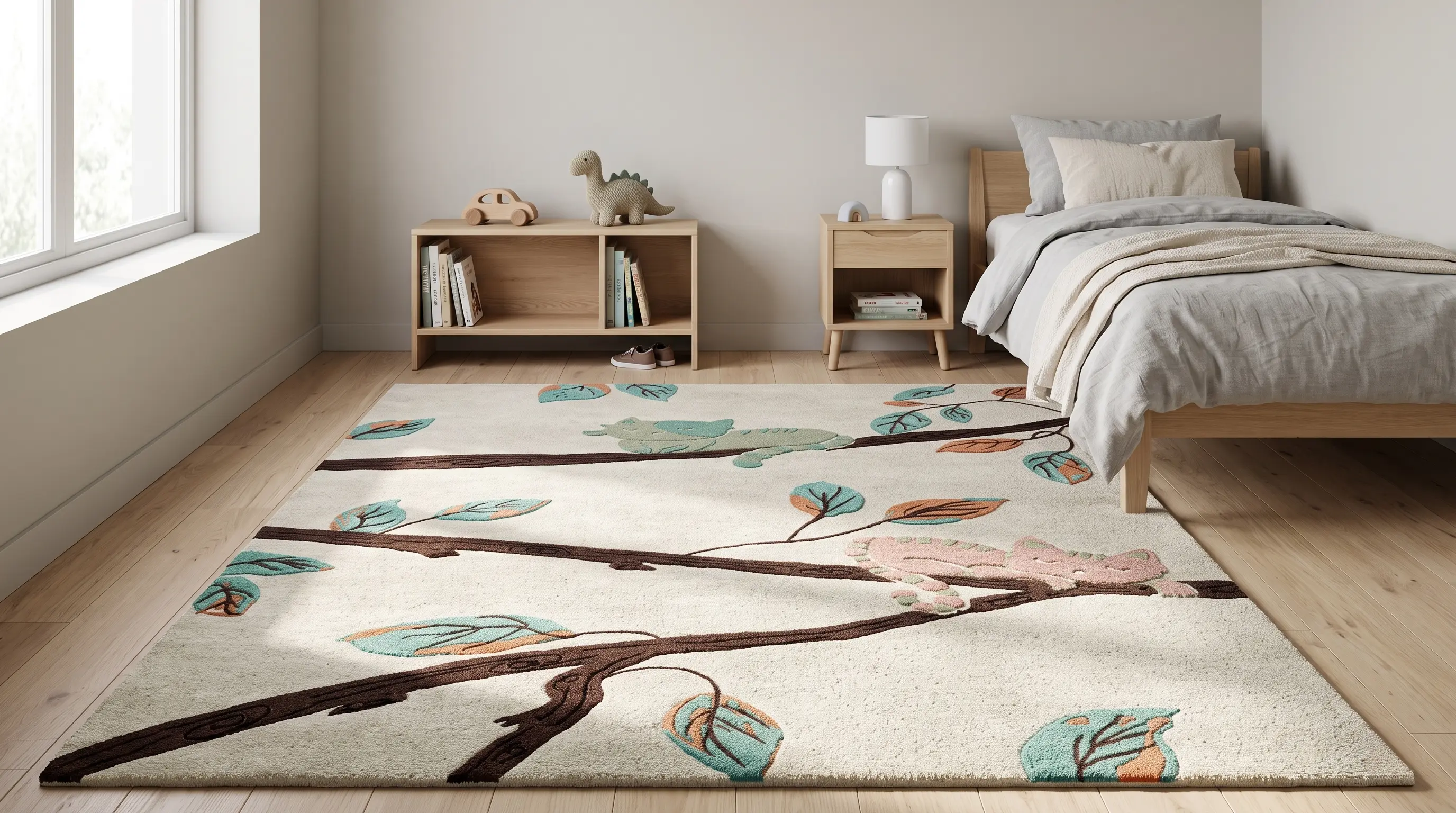
And why most kids' rugs stop working far too soon
Most kids' rooms are designed for a moment.
Bright colours, playful themes, character-based designs - they work for a while. But as the child grows, the space starts to feel out of sync. What once felt fun begins to feel limiting.
The same thing often happens with rugs.
They are chosen for a specific age, not for how the space will evolve.
Why Most Kids' Rugs Don't Last
In most homes, I've noticed that kids' rugs are chosen with short-term thinking.
- Designs are overly themed
- Colours are too loud or restrictive
- Patterns are tied to a specific age group
As a result, the rug feels outdated much sooner than the rest of the room.
It's not a quality issue. It's a design approach issue.
What "Growing With the Space" Actually Means
A rug that grows with your child does not need to be replaced as their preferences change.
Instead, it should:
- Work across different ages
- Adapt to changing layouts
- Feel relevant even as the room evolves
This doesn't mean the rug has to be plain.
It just needs to be designed with more flexibility.
Choose Design Over Theme
One of the biggest shifts I've made while designing for kids' spaces is moving away from literal themes.
Instead of:
- Character-based visuals
- Overly defined motifs
I prefer:
- Abstract elements
- Suggestive forms
- Open compositions
In pieces like KOI, the idea was to introduce movement and calm through flowing forms, rather than defining the space too rigidly. It allows the rug to feel playful early on, and still relevant later.
Why Balance Matters More Than Brightness
There's a tendency to rely heavily on bright colours in kids' spaces.
But too much visual activity can make a room feel cluttered over time.
A more balanced approach:
- Uses colour in a controlled way
- Allows calmer areas to exist
- Creates engagement without overstimulation
This balance is what allows a space to remain usable as it evolves.
The Role of Space in Kids Rug Design
Empty space is often overlooked, but it's critical.
Rugs that are filled edge-to-edge tend to feel heavy and limiting.
In contrast, designs with breathing room:
- Feel lighter
- Adapt better to changing furniture
- Age more naturally
For example, in a piece like ALFIE, the border carries the visual energy, while the centre is intentionally quieter. This allows the rug to frame the room rather than dominate it.
How Texture (Haptics) Supports a Child's Development
Beyond how a rug looks, how it feels is equally important - especially in early years.
In my work, I often explore high-low pile variations to create subtle tactile differences.
These variations:
- Encourage sensory interaction
- Help children engage with the surface through movement
- Add depth without relying only on colour or pattern
This kind of haptic experience allows the rug to remain engaging without being visually overwhelming.
It also adds a layer of relevance that isn't tied to age, but to how the space is experienced physically.
Think Beyond "Kids Only"
A useful way to evaluate a rug is to ask:
Would this still work outside a kids' room?
If the answer is yes, the design is likely flexible enough to last.
How to Choose the Right Kids' Room Rug
A few practical checks I usually follow:
- Avoid overly specific themes
- Work with controlled colour palettes
- Focus on composition and spacing
- Use texture to add depth
- Think beyond immediate use
If You're Designing a Kid's Room From Scratch
I usually prefer starting with the rug.
It helps:
- Anchor the space
- Set the tone
- Allow other elements to evolve around it
Final Thought
Kids' spaces don't need to be temporary.
With the right design approach, they can evolve naturally without constant replacement.
The rug plays a bigger role in that than most people realise.
Choose one that doesn't just fit the moment, but continues to make sense as the space changes.