
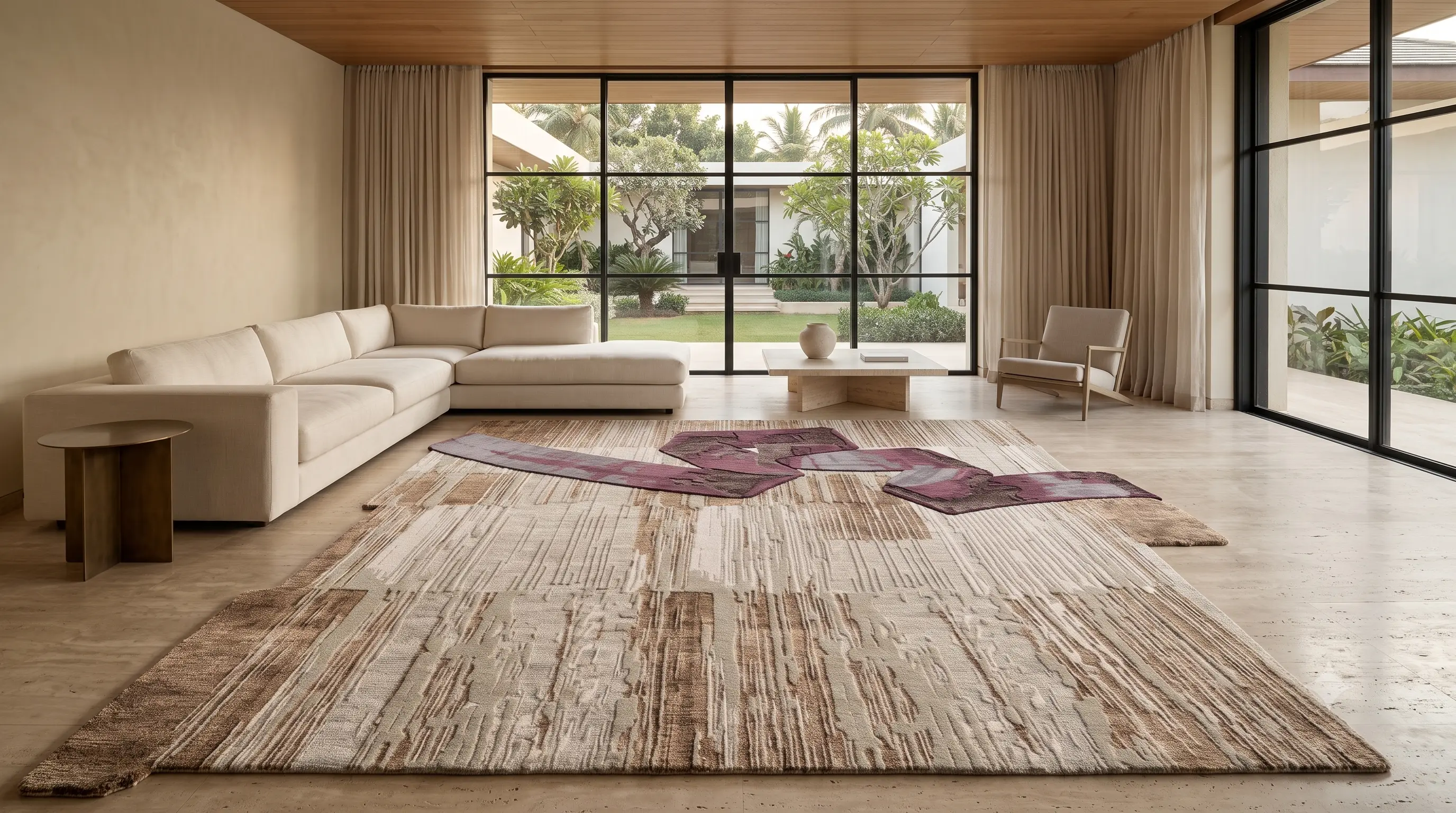
Most living rooms feel incomplete, not because of decor, but because the rug is too small or poorly placed. Choosing the right rug size and positioning it correctly can completely change how your space looks and feels.
Most people assume a rug fails because of how it looks. The colour feels wrong, the texture does not match, or the pattern does not work with the rest of the room. But in reality, that is rarely the problem.
A rug can be perfectly chosen in terms of material and style, and the room can still feel slightly off. Not uncomfortable, not obviously wrong, just incomplete. That subtle lack of cohesion usually comes down to something far less obvious: size and placement.
Why treating a rug like an accessory does not work
In many homes, the rug is an afterthought. It is added at the end, once the furniture is already in place, as something to fill empty space. Because of this, it often ends up floating in the center of the room, sitting under only the coffee table, or stopping short of the seating area entirely.
Visually, this creates separation. The sofa feels like one zone, the chairs feel like another, and the rug does not belong to either. Even if everything else in the room works, the space lacks unity.
What a rug is actually supposed to do in a living room
A rug is not just decorative, it is structural. Its role is to anchor the room and define the seating area. When it is placed correctly, it quietly organizes the space without drawing attention to itself.
You do not notice the rug. You notice that the room suddenly feels complete.
The most common mistake: choosing a rug that is too small
The most frequent issue is choosing a rug that is too small. Typically, this means a rug that sits only under the center table, leaves all furniture legs outside its edges, or creates visible gaps between key elements.
This has a noticeable impact on how the room feels. It can make the space appear smaller, more fragmented, and visually lighter than intended. Ironically, people often choose smaller rugs to save space, but the result is the opposite. The room feels less grounded and more disjointed.
How to choose the right rug size and placement
You do not need strict rules, but you do need to think in terms of proportion and connection.
A simple shift in approach can fix most rug-related issues:
- Let the rug interact with the furniture. At minimum, the front legs of your sofa and chairs should sit on the rug. This immediately ties the seating together and creates a defined, intentional layout.
- Think in terms of coverage, not just fit. Instead of asking whether a rug fits a specific spot, consider whether it can hold the entire seating area together. This change in perspective leads to better choices.
- When in doubt, go slightly larger. A slightly oversized rug feels deliberate and cohesive. A slightly undersized rug feels accidental. Even if you cannot immediately explain the difference, you can feel it.
Rule of thumb: Your rug should be large enough for at least the front legs of all seating to sit on it and ideally extend beyond the edges of the sofa.
Why rug sizing mistakes are so common
Rugs are typically chosen in isolation, viewed online, seen in a store, or imagined as standalone pieces. But they do not function that way in real spaces.
A rug only works when it is considered in relation to furniture, layout, and movement. It is not just an object, it is part of a system.
A better way to think about rugs
Instead of focusing on how a rug looks on its own, shift the question:
Not 'Does this rug look good?' but 'Does this rug complete the room?'
Because the right rug does not stand out. It brings everything else together.
If your living room feels almost right
If your space feels close but not quite there, avoid replacing major elements like the sofa or lighting right away.
Start with the rug.
Look at how it sits, how it connects or does not connect, and whether it actually defines the space.
Sometimes, a simple shift on the floor is what finally makes the entire room come together.